

Pouke iz života Junusa, a.s. – Iskušenja koja nas vraćaju Allahu

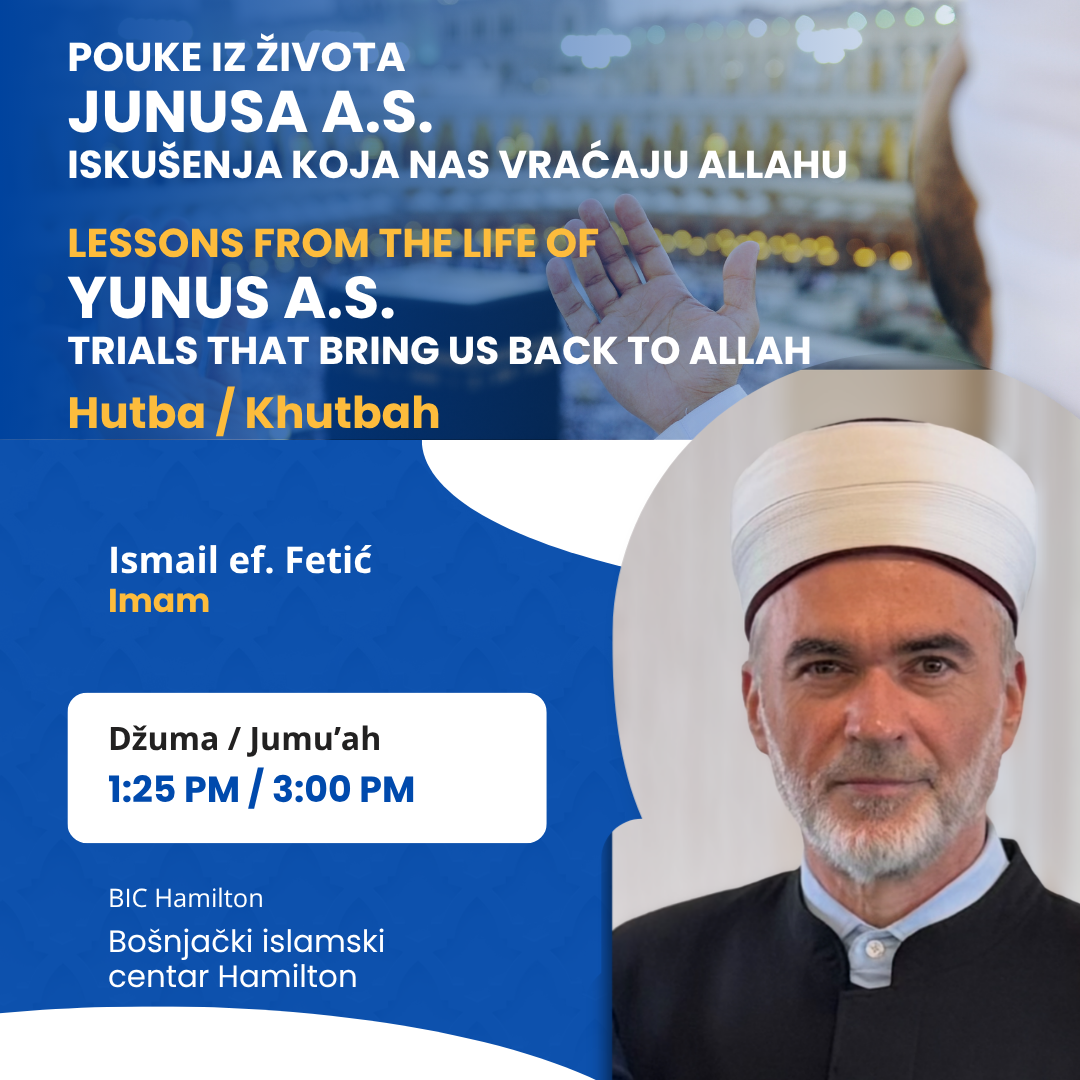 Pouke iz života Junusa, a.s. – Iskušenja koja nas vraćaju Allahu
Hvala Allahu, Gospodaru svih svjetova. Njega hvalimo, od Njega pomoć i oprost tražimo, i molimo Ga da nas uputi i učvrsti na Pravome putu. Neka su salavat i selam na našeg voljenog Poslanika Muhammeda, sallallahu alejhi ve sellem, njegovu porodicu, ashabe i sve one koji slijede njegov put do Sudnjeg dana.
Draga braćo i sestre,
Nema čovjeka na ovom svijetu koji nije iskušan. Neko je iskušan bolešću, neko siromaštvom, neko problemima u porodici, neko gubitkom voljene osobe, a neko brigama koje niko drugi ne vidi. Život vjernika nije život bez iskušenja. Naprotiv, iskušenja su sastavni dio puta prema Allahu. Pitanje nije hoćemo li biti iskušani, nego kako ćemo se ponašati kada iskušenje dođe.
Jedna od najljepših kur’anskih priča koja nas tome uči jeste priča o Allahovom poslaniku Junusu, a.s. Njegova priča nije samo priča o čovjeku kojeg je progutala velika riba. To je priča o svakome od nas. Priča o trenucima kada se osjećamo izgubljeno, nemoćno i zarobljeno vlastitim problemima, ali i priča o tome kako pronaći izlaz kada nam se čini da izlaza više nema.
Braćo i sestre,
Junus, a.s., je bio Allahov poslanik poslan svome narodu. Godinama ih je pozivao da vjeruju u Allaha i ostave mnogoboštvo. Govorio im je istinu, savjetovao ih, upozoravao ih na posljedice njihovih djela i strpljivo ih pozivao na Pravi put. Međutim, većina njegovog naroda odbijala je njegov poziv i ostajala u svom nevjerovanju.
Nakon dugog vremena, Junus, a.s., osjetio je razočarenje i napustio je svoj narod prije nego što mu je Allah dao dozvolu da to učini. Ukrcao se na brod misleći da iza sebe ostavlja probleme, teškoće i razočarenja. Ali Allah je za njega pripremio veliku životnu lekciju koja će ostati pouka svim generacijama do Sudnjega dana.
Na moru je nastala snažna oluja koja je prijetila da potopi brod. Putnici su odlučili baciti kocku kako bi odredili ko će biti bačen u more da bi se brod rasteretio i spasio. Kocka je pala na Junusa, a.s., i on je završio u moru gdje ga je Allahovom odredbom progutala velika riba.
Zamislite samo taj trenutak. Mrak noći, dubina mora i utroba ribe spojili su se u tri sloja tame iz kojih nije bilo ljudskog izlaza. Nije bilo porodice da pomogne, nije bilo prijatelja da pruže podršku, niti čovjeka koji bi mogao promijeniti njegovu situaciju. U tim trenucima potpune nemoći Junus, a.s., spoznao je veliku istinu koju svaki vjernik mora naučiti: kada se zatvore sva vrata na Zemlji, vrata kod Allaha ostaju otvorena.
Draga braćo i sestre,
Mnogi od nas prošli su kroz vlastite tame. Neko je sjedio u bolnici čekajući rezultate nalaza i strepeći od onoga što će čuti. Neko brine za svoje dijete koje se udaljava od vjere ili donosi pogrešne životne odluke. Neko se bori sa usamljenošću, depresijom, stresom ili brigama koje nosi u sebi i ne dijeli ih ni sa kim. Neko pokušava pronaći izlaz iz finansijskih problema, dok neko drugi nosi bol zbog smrti voljene osobe.
Možda se naše okolnosti razlikuju, ali osjećaj je često isti. Osjećamo se nemoćno, zarobljeno i izgubljeno, pitajući se ima li izlaza iz onoga kroz šta prolazimo. Upravo tada trebamo se sjetiti Junusa, a.s., i načina na koji se on obratio svome Gospodaru.
Dok je bio u utrobi ribe, izgovorio je dovu koja je ostala pouka svim generacijama muslimana: “La ilahe illa Ente, subhaneke inni kuntu minez-zalimin.” “Nema boga osim Tebe. Slavljen neka si Ti. Ja sam se zaista prema sebi ogriješio.” (El-Enbija, 87)
Pogledajmo pažljivo ovu dovu. Junus, a.s., se nije žalio na svoju sudbinu, nije krivio druge za ono što mu se dogodilo niti je gubio nadu u Allahovu milost. Umjesto toga, potpuno se okrenuo Allahu, priznao Njegovu veličinu, priznao vlastitu slabost i prepustio se Njegovoj milosti.
U ovoj kratkoj, ali veličanstvenoj dovi nalaze se tri velike životne lekcije.
Prva lekcija je tevhid, potpuno oslanjanje na Allaha. Riječi: “Nema boga osim Tebe” podsjećaju nas da konačna pomoć ne dolazi od ljudi, novca, položaja ili naših sposobnosti. Sve to može biti sredstvo, ali pravi spas i izlaz dolaze samo od Allaha.
Druga lekcija jeste poniznost pred Uzvišenim Gospodarom. Kada Junus, a.s., kaže: “Subhaneke – Slavljen neka si Ti”, on priznaje Allahovu savršenost i vlastitu slabost. Iskušenja nas često podsjete koliko smo zapravo ovisni o Allahu i koliko nam je potrebna Njegova pomoć. Nerijetko nas upravo iskušenja vrate Allahu više nego godine lagodnog života.
Treća lekcija jeste samopreispitivanje. Umjesto da traži krivca u drugima, Junus, a.s., kaže: “Ja sam se zaista prema sebi ogriješio.” To je osobina iskrenih vjernika. Danas živimo u vremenu kada ljudi lahko pronalaze greške kod drugih, ali teško priznaju vlastite propuste. Vjernik prvo preispituje sebe, popravlja sebe i traži Allahov oprost za svoje nedostatke.
Braćo i sestre,
Nakon što je iskreno uputio ovu dovu, Allah je uslišao Junusa, a.s., i spasio ga iz nevolje. Uzvišeni Allah kaže: “Pa smo mu se odazvali i iz nevolje ga spasili. Tako Mi spašavamo vjernike.” (El-Enbija, 88)
Posebnu pažnju zaslužuje završetak ovog ajeta. Allah nije rekao: “Tako smo spasili Junusa”, nego kaže: “ Tako Mi spašavamo vjernike.” Time nam poručuje da ova priča nije samo historijski događaj iz života jednog poslanika. To je poruka svakom vjerniku koji se iskreno vrati Allahu i osloni na Njega. Allah koji je spasio Junusa može pomoći i nama. Allah koji ga je izveo iz tame može i naše živote ispuniti svjetlom. Allah koji je uslišao njegovu dovu može uslišati i naše dove.
Draga braćo i sestre,
Jedna od velikih zabluda našeg vremena jeste uvjerenje da vjernik ne bi trebao imati problema i iskušenja. Međutim, kada pogledamo živote Allahovih poslanika, vidimo da su upravo oni bili najviše iskušavani. Nuh, a.s., bio je ismijavan od svoga naroda. Ibrahim, a.s., bio je bačen u vatru. Musa, a.s., bio je proganjan od faraona. Ejjub, a.s., izgubio je zdravlje i imetak. Junus, a.s., završio je u utrobi ribe.
Ako su najbolji Allahovi robovi bili iskušavani, kako onda mi možemo očekivati život bez iskušenja?
Iskušenja nisu znak da nas Allah ne voli. Vrlo često su znak Njegove brige za nas. Kroz iskušenja Allah čisti naše grijehe, jača naš karakter, povećava naše oslanjanje na Njega i podsjeća nas na ono što je zaista važno. Nekada Allah promijeni naše okolnosti, a nekada kroz okolnosti promijeni nas same. U oba slučaja radi se o Njegovoj milosti.
Braćo i sestre,
Mi danas u Kanadi možda nemamo iste probleme kao mnogi ljudi u svijetu. Većina nas ima sigurnost, krov nad glavom i dovoljno hrane. Međutim, imamo druga iskušenja: iskušenje nemara prema vjeri, iskušenje pretjerane vezanosti za dunjaluk, iskušenje društvenih mreža, zabave i života u kojem se lahko zaboravi na Allaha, dž.š.
Možemo postati toliko zauzeti gradnjom svog dunjaluka da zanemarimo gradnju svoje veze sa Allahom. Zato nas priča o Junusu, a.s., podsjeća da uspjeh nije u tome da pobjegnemo od iskušenja, nego da kroz iskušenja pronađemo put do Allaha. Kada ti bude teško, sjeti se Junusa, a.s. Kada se osjetiš izgubljeno, sjeti se Junusa, a.s. Kada pomisliš da nema izlaza iz tvoje situacije, sjeti se Junusa, a.s., i njegove dove: “La ilahe illa Ente, subhaneke inni kuntu minez-zalimin.”
Uči je kada si bolestan, kada si zabrinut, kada si pod stresom, kada si tužan i kada osjetiš da ti je srce daleko od Allaha. To nije samo dova jednog poslanika; to je dova svakog vjernika koji traži Allahovu pomoć, oprost i milost.
Draga braćo i sestre,
Priča o Junusu, a.s., uči nas da nijedna situacija nije beznadežna, nijedan grijeh nije veći od Allahove milosti, nijedna nevolja nije jača od Allahove pomoći i nijedna tama nije dublja od Allahovog svjetla. Sve dok se iskreno vraćamo Allahu i ne gubimo nadu u Njegovu milost, vrata Njegove pomoći ostaju otvorena.
Molimo Allaha Uzvišenog da nam podari sabur u iskušenjima, da nam podari snagu kada posustanemo, da nam srca ispuni osloncem na Njega, da usliša naše dove i da nam podari izlaz iz svake teškoće kao što ga je podario Svome poslaniku Junusu, a.s. Amin, ja Rabbe-l-’alemin.
Lessons from the life of Prophet Yunus – Trials that bring us back to Allah
All praise is due to Allah, the Lord of all worlds. We praise Him, seek His help and forgiveness, and ask Him to guide us and keep us firm on the Straight Path. May Allah’s peace and blessings be upon our beloved Prophet Muhammad, sallallahu alayhi wa sallam, his family, his companions, and all those who follow his path until the Day of Judgment.
Dear brothers and sisters,
There is no person in this world who goes through life without being tested. Some are tested with illness, others with financial difficulties, family problems, the loss of a loved one, or worries that no one else can see. The life of a believer is not a life without trials. Rather, trials are part of the journey toward Allah. The question is not whether we will be tested, but how we will respond when those tests arrive.
One of the most powerful stories in the Qur’an that teaches us how to deal with hardship is the story of Prophet Yunus, peace be upon him. His story is not simply about a man who was swallowed by a great fish. It is a story about every one of us. It is a story about moments when we feel lost, overwhelmed, and trapped by our circumstances, and about how to find hope when it seems that there is no way out.
Dear believers,
Yunus, a.s., was a prophet sent by Allah to guide his people. For years he called them to worship Allah alone and abandon their false beliefs. He spoke the truth, advised them sincerely, warned them of the consequences of their actions, and patiently invited them to the Straight Path. Yet most of his people continued to reject his message and refused to change.
After many years, Yunus, a.s., became deeply disappointed. He left his people before Allah had given him permission to do so. He boarded a ship thinking he was leaving behind his frustrations, his struggles, and his disappointments. However, Allah had prepared a lesson for him that would become a source of guidance for believers until the end of time.
While at sea, a violent storm threatened to sink the ship. The passengers decided to draw lots to determine who would be cast overboard so that the ship could be saved. The lot fell upon Yunus, a.s., and he was thrown into the sea, where Allah decreed that a great fish would swallow him.
Imagine that moment. The darkness of the night, the darkness of the deep ocean, and the darkness inside the belly of the fish surrounded him from every side. There was no family to help him, no friends to support him, and no human being who could change his situation. In that moment of complete helplessness, Yunus, a.s., realized a truth that every believer must learn: when every door on earth closes, the door of Allah remains open.
Dear brothers and sisters,
Many of us have experienced our own forms of darkness. Some have sat in hospital rooms anxiously waiting for test results. Some worry about children who are drifting away from faith or making harmful choices. Others struggle with loneliness, depression, stress, or burdens they carry silently. Some are trying to overcome financial hardships, while others continue to grieve the loss of someone they loved dearly.
Our situations may be different, but the feeling is often the same. We feel trapped, overwhelmed, and unsure of how things will improve. It is in those moments that we should remember Yunus, a.s., and the way he turned to his Lord.
While inside the belly of the fish, he made a du‘a that has become a source of comfort and hope for generations of believers:
“La ilaha illa Anta, Subhanaka inni kuntu minaz-zalimin.”
“There is no god except You. Glory be to You. Indeed, I have been among the wrongdoers.” (Surah Al-Anbiya, 87)
When we reflect on this du‘a, we notice something remarkable. Yunus, a.s., did not complain about his situation, nor did he blame others for what had happened to him. He did not lose hope in Allah’s mercy. Instead, he turned completely to Allah, acknowledged His greatness, admitted his own weakness, and placed himself entirely in the care of his Lord.
Within this short but profound supplication are three important lessons.
The first lesson is Tawhid, complete reliance upon Allah. When Yunus, a.s., said, “There is no god except You,” he reminded himself that ultimate help does not come from people, wealth, status, or personal ability. These may be means, but true rescue comes only from Allah.
The second lesson is humility. By saying, “Glory be to You,” Yunus, a.s., acknowledged Allah’s perfection and his own limitations. Trials often remind us how dependent we are upon Allah. Sometimes hardship brings us closer to Allah than years of comfort ever could.
The third lesson is self-reflection. Instead of blaming others, Yunus, a.s., said, “Indeed, I have been among the wrongdoers.” This is the quality of sincere believers. We live in a time when people are quick to point out the faults of others but slow to recognize their own shortcomings. A believer begins by examining and correcting himself before criticizing others.
Dear brothers and sisters,
After Yunus, a.s., sincerely made this du‘a, Allah responded to him and delivered him from his distress. Allah says: “So, We responded to him and rescued him from the distress. And thus, do We save the believers.” (Surah Al-Anbiya, 88)
Pay close attention to the ending of this verse. Allah did not say, “Thus We saved Yunus.” Instead, He says, “Thus do We save the believers.”
This means that the story is not only about Yunus, a.s. It is a message for every believer who sincerely turns back to Allah and places his trust in Him. The Allah who saved Yunus can help us. The Allah who brought him out of darkness can bring light into our lives. The Allah who answered his supplication can answer ours as well.
Dear believers,
One of the great misunderstandings of our time is the idea that faith should protect us from every hardship. Yet when we look at the lives of Allah’s prophets, we see that they were tested more than anyone else. Nuh, a.s., was mocked by his people. Ibrahim, a.s., was thrown into the fire. Musa, a.s., was pursued by Pharaoh. Ayyub, a.s., lost his health and wealth. Yunus, a.s., found himself in the belly of a fish. If the best of Allah’s servants faced severe trials, how can we expect a life free from difficulties?
Trials are not signs that Allah has abandoned us. Very often they are signs of His care for us. Through hardship, Allah purifies us from sins, strengthens our character, increases our reliance upon Him, and reminds us of what truly matters. Sometimes Allah changes our circumstances, and sometimes He changes us through our circumstances. Both are forms of His mercy.
Dear brothers and sisters,
Living in Canada, many of us may not face the same struggles as people in other parts of the world. Most of us have food on our tables, roofs over our heads, and a level of security that many others can only dream of. Yet we face different kinds of tests: the test of heedlessness, the test of materialism, the test of endless distractions, and the test of becoming so busy with building our worldly lives that we neglect our relationship with Allah.
The story of Yunus, a.s., reminds us that success is not found in escaping trials. Success is found in finding our way back to Allah through those trials. When life becomes difficult, remember Yunus, a.s. When you feel lost, remember Yunus, a.s. When you think there is no way forward, remember Yunus, a.s., and his beautiful supplication: “La ilaha illa Anta, Subhanaka inni kuntu minaz-zalimin.”
Recite it when you are sick. Recite it when you are worried. Recite it when you are stressed. Recite it when you are grieving. Recite it whenever you feel distant from Allah. It is not only the du‘a of a prophet. It is the du‘a of every believer seeking Allah’s help, forgiveness, and mercy.
Dear brothers and sisters,
The story of Yunus, a.s., teaches us that no situation is hopeless, no sin is greater than Allah’s mercy, no hardship is stronger than Allah’s power, and no darkness is deeper than Allah’s light. As long as we sincerely return to Allah and never lose hope in His mercy, the doors of His help remain open.
We ask Allah to grant us patience during our trials, strength when we feel weak, hearts that rely upon Him alone, and relief from every hardship just as He granted relief to His Prophet Yunus, a.s. Ameen, Ya Rabbal-‘Alamin.
Imam Ismail Fetic