

Bajramska hutba 1447. H- Kurban-bajram: Povratak Allahu kroz žrtvu i iskrenost

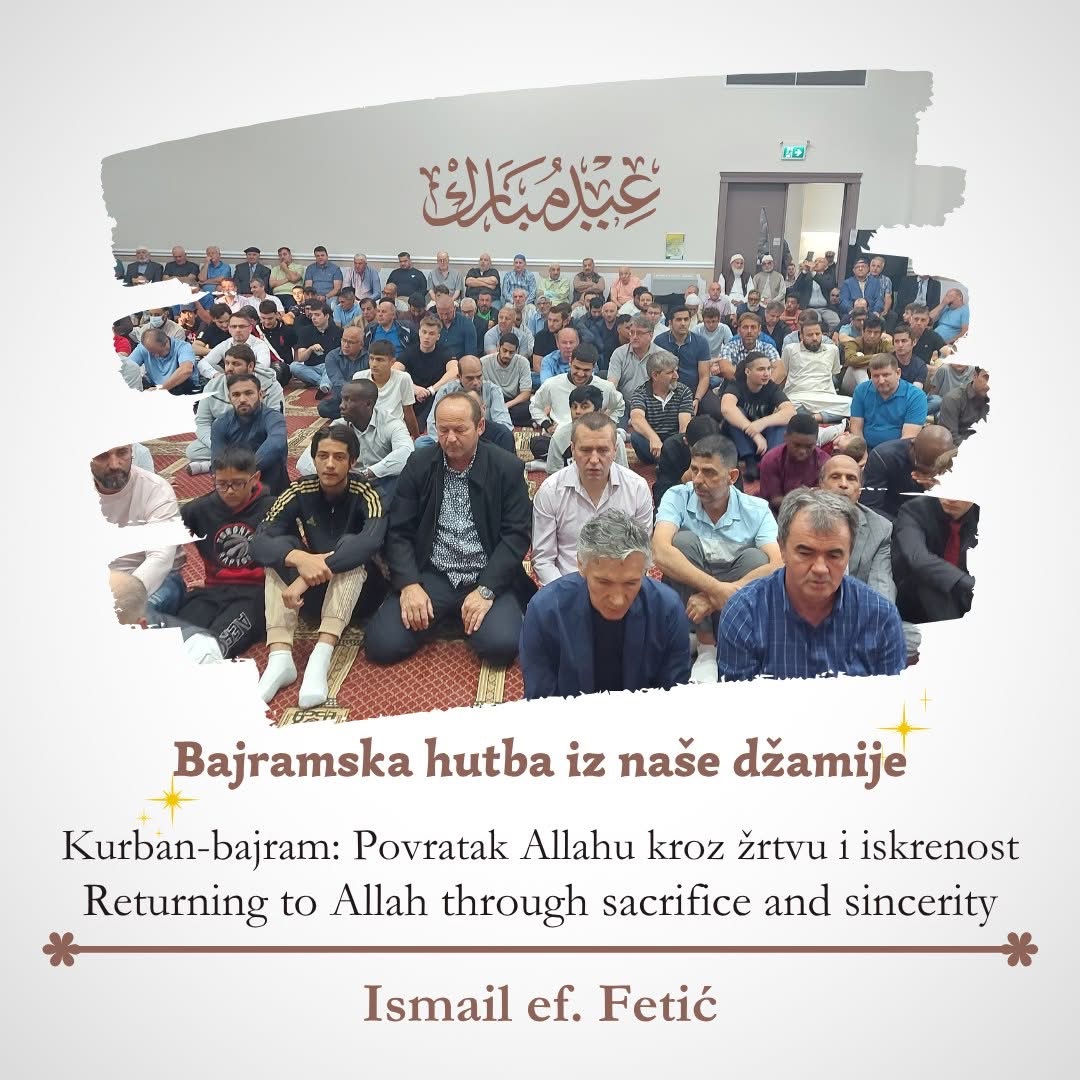 Bajramska hutba 1447. H
Kurban-bajram: Povratak Allahu kroz žrtvu i iskrenost
Hvala Allahu, Gospodaru svih svjetova, Koji nam je dao da dočekamo ove mubarek dane Kurban bajrama, da stojimo jutros u safovima naše lijepe džamije, zajedno sa svojim porodicama, braćom i sestrama u vjeri, i da osjetimo ljepotu imana dok izgovaramo tekbire koji odzvanjaju našim srcima i našim domovima. Neka su salavat i selam na našeg voljenog Poslanika Muhammeda, sallallahu alejhi ve sellem, na njegovu časnu porodicu, njegove plemenite ashabe i sve one koji njegovim putem idu do Sudnjega dana.
Draga braćo i sestre, djeco i omladino, danas ne obilježavamo samo još jedan Bajram, niti je ovo samo dan radosti i okupljanja, nego stojimo između dvije stvarnosti – između dunjaluka koji nas često umori, optereti i udalji jedne od drugih, i između istine koja nas vraća Allahu, dželle šanuhu, podsjećajući nas ko smo i zašto smo stvoreni.
Zato Bajram nije samo radost. Nije samo običaj i susret. Bajram je poruka, podsjetnik i pitanje svakome od nas: gdje smo danas u odnosu na Allaha i kakav je naš odnos prema Njemu?
Jučer su milioni muslimana stajali na Arefatu, uzdignutih ruku, otvorenih srca i uplakanih očiju, moleći svoga Gospodara za oprost i milost. Dok su oni stajali tamo, mi smo ovdje postili, klanjali i dovili. Vjerujmo da Allah gleda i jedne i druge. Prima i njihov hadždž i našu iskrenost. Zato Ga danas molimo: Gospodaru naš, primi od njih njihov hadždž, a od nas naše dove, naše ibadete i naš trud. Nemoj nas udaljiti od Svoje milosti i Svoje blizine.
Braćo i sestre, Kurban-bajram nas vraća jednoj od najdubljih i najpotresnijih priča u historiji čovječanstva, priči o Ibrahimu i Ismailu, alejhimesselam, priči o ocu i sinu. To je priča o žrtvi, pokornosti i potpunom oslanjanju na Allaha. Nije to samo historija. To je ogledalo u kojem trebamo vidjeti sami sebe i zapitati se šta smo mi danas spremni žrtvovati radi Allaha. I kada Ismail reče: يَا أَبَتِ افْعَلْ مَا تُؤْمَرُ
“O oče moj, učini ono što ti je naređeno…” To je iman koji ne pregovara. Iman koji ne traži izgovore i ne odgađa. A mi danas često biramo šta ćemo izvršiti, a šta ostaviti. Klanjamo kada imamo vremena, dajemo kada nam ostane i opraštamo kada nam odgovara. Zato nas Bajram poziva da se vratimo iskrenosti, pokornosti i istinskom odnosu prema Allahu, dželle šanuhu.
Kurban koji danas prinosimo nije samo meso koje dijelimo. To je simbol naše bogobojaznosti. Allahu ne dolazi ni meso ni krv, nego dolazi naša iskrenost i stanje naših srca. Zato se zapitajmo, braćo i sestre: šta iz našeg života zaista dolazi do Allaha – naši običaji ili naša iskrenost, naši postupci ili naša srca?
Draga braćo i sestre u dini-Islamu, živimo u vremenu velikih iskušenja. Vremenu u kojem se ljudi udaljavaju jedni od drugih. U kojem porodice slabe, a veze se kidaju. Vremenu u kojem mnogi ljudi imaju sve više stvari, a sve manje mira u srcu.
Koliko je ljudi prošlog Bajrama bilo sa nama u safovima, a danas ih nema? Koliko je onih koji su planirali još jedan Bajram sa svojom porodicom, ali ih je Allah pozvao Sebi prije nego što su dočekali ovo jutro? Zato današnji Bajram treba da nas probudi iz nemara i podsjeti koliko je život prolazan.
I dok se mi danas radujemo sa svojim porodicama, postoje majke koje ovaj Bajram dočekuju bez svoje djece, i djeca koja Bajram dočekuju bez sigurnosti, doma i roditeljskog zagrljaja. Postoje muslimani koji Bajram dočekuju pod strahom, bombardovanjem i neizvjesnošću.
Ne zaboravimo Palestinu. Ne zaboravimo Gazu. Ne zaboravimo mjesta gdje muslimani danas pate. Zato ovaj Bajram nije samo radost. On je i odgovornost. Odgovornost da se sjetimo onih koji danas nemaju ono što mi imamo. Ako smo siti, sjetimo se gladnih. Ako smo sigurni, sjetimo se onih koji žive u strahu. Ako smo zajedno sa svojim porodicama, sjetimo se onih koji su ostali sami, zaboravljeni i bez svojih najmilijih. Jer vjernik ne živi samo za sebe. Srce muslimana treba da osjeća bol svoga ummeta, ma gdje on bio. Naš voljeni Poslanik, sallallahu alejhi ve sellem, naučio nas je da su vjernici kao jedno tijelo. Kada jedan dio boli, cijelo tijelo osjeća. Zato se zapitajmo: osjećamo li bol naše braće i sestara, ili smo se udaljili i postali ravnodušni?
Draga braćo i sestre, Bajram je prilika da se vratimo jedni drugima. Da oprostimo. Da nazovemo. Da zagrlimo. Da prekinemo šutnju koja možda traje predugo. Jer koliko je danas podijeljenih porodica? Koliko braće i sestara ne govori? Koliko djece ne zove roditelje zbog ponosa i tvrdog srca? Ne dozvoli da ti Bajram prođe, a da tvoje srce ostane zatvoreno. Ako treba, ti napravi prvi korak. Allah voli one koji mire i koji spajaju ono što je prekinuto.
Ne zaboravimo naše roditelje. Oni koji ih imaju neka im danas pokažu još više ljubavi i pažnje. A oni koji ih nemaju neka ih se sjete dovom i rahmetom. Ne zaboravimo bolesne, starije, naše komšije, i muslimane i nemuslimane. Jer islam se ne pokazuje samo riječima, nego djelima i lijepim ponašanjem koje ostavlja trag.
Braćo i sestre, Bajram je radost duše koja zna zašto živi. Raduj se, ali ne zaboravi Allaha. Okupljaj se, ali ne zaboravi dovu. Neka se u našim kućama danas čuje tekbir, ali i iskrena riječ, osmijeh i zahvalnost Allahu, dželle šanuhu, na svemu što nam je dao. I ne dozvolimo da nam Bajram ostane samo na novoj odjeći, lijepoj hrani i fotografijama. Neka ovaj Bajram bude povratak Allahu, povratak namazu, porodici, milosti i iskrenosti.
Molim Allaha, dželle šanuhu, da primi naše kurbane, da očisti naša srca, da ojača naše porodice, da ujedini naš Ummet, da olakša svima koji su u nevolji i da nas učini od onih koji ne samo da dočekuju Bajram nego ga istinski žive. Gospodaru naš, nemoj nas udaljiti od Sebe. Podari nam iskrenost Ibrahima, sabur Ismaila i milost našeg voljenog Poslanika Muhammeda, sallallahu alejhi ve sellem.
Bajram šerif mubarek olsun.
Eid Khutbah 1447 H
Eid al-Adha: Returning to Allah through sacrifice and sincerity
All praise belongs to Allah, Lord of all worlds, Who has allowed us to witness these blessed days of Eid al-Adha, to stand this morning in the rows of our beautiful mosque together with our families, our brothers and sisters in faith, and to feel the beauty of iman while reciting the takbirs that echo through our hearts and our homes. May peace and blessings be upon our beloved Prophet Muhammad (s.a.w.s.), upon his noble family, his honored companions, and all those who follow his path until the Day of Judgment.
Dear brothers and sisters, dear children and youth, today is not simply another Eid. This is not only a day of celebration, gathering, and beautiful clothes. Today we stand between two realities: between the dunya that often exhausts us, burdens us, and distances us from one another, and between the truth that brings us back to Allah SWT, reminding us of who we are and why we were created. That is why Eid is not only joy. It is also a message, a reminder, and a question for every one of us: Where do we stand today in our relationship with Allah?
Yesterday, millions of Muslims stood on the plains of ‘Arafah with raised hands, open hearts, and tearful eyes, begging Allah for forgiveness and mercy. While they stood there, we were here fasting, praying, and making du‘a. And we believe that Allah sees both. He accepts their Hajj and He accepts our sincerity. So today we ask Him: Our Lord, accept from them their Hajj, and accept from us our prayers, our du‘as, and our efforts. Do not distance us from Your mercy and closeness.
Dear brothers and sisters, Eid al-Adha brings us back to one of the most emotional and powerful stories in human history, the story of Ibrahim and Isma‘il a.s., the story of a father and a son. It is a story of sacrifice, obedience, and complete trust in Allah. And it is not simply history. It is a mirror in which we should see ourselves and ask: What are we willing to sacrifice for Allah today?
When Isma‘il said: يَا أَبَتِ افْعَلْ مَا تُؤْمَرُ “O my father, do as you are commanded.” (Surah As-Saffat, 37:102) That is faith that does not negotiate. Faith that does not search for excuses or delay obedience. But many of us today choose what we will practice and what we will ignore. We pray when it is convenient. We give when we have extra. We forgive only when it suits us. That is why Eid calls us back to sincerity, obedience, and a genuine relationship with Allah SWT.
The qurbani we offer today is not merely meat that we distribute. It is a symbol of our taqwa. Allah tells us that neither the meat nor the blood reaches Him, what reaches Him is our sincerity and the condition of our hearts. So, let us ask ourselves today: What from our lives truly reaches Allah? Our habits or our sincerity? Our appearances or our hearts?
Dear brothers and sisters in Islam, we live in difficult times. Times in which people are becoming distant from one another. Families are weakening. Relationships are breaking. Many people have more possessions than ever before, yet less peace in their hearts. How many people were with us last Eid, standing in these same rows, but are no longer here today? How many planned one more Eid with their families, but Allah called them back before they could witness this morning? Today’s Eid should wake us from heedlessness and remind us how temporary this life truly is.
And while we celebrate with our families today, there are mothers spending Eid without their children, and children spending Eid without safety, homes, or the embrace of their parents. There are Muslims celebrating Eid under fear, bombardment, and uncertainty. Let us not forget Palestine. Let us not forget Gaza. Let us not forget the places where Muslims are suffering today. That is why Eid is not only joy. It is also responsibility. If we are full, we must remember the hungry. If we are safe, we must remember those living in fear. If we are together with family, we must remember those who are lonely and forgotten. Our beloved Prophet (pbuh) taught us that believers are like one body, when one part suffers, the entire body feels the pain.
So, let us ask ourselves: Do we still feel the pain of our brothers and sisters, or have we become distant and numb?
Dear brothers and sisters, Eid is also an opportunity to return to one another. To forgive. To call someone. To embrace someone. To break a silence that may have lasted far too long. How many divided families are there today? How many brothers and sisters no longer speak? How many children no longer call their parents because of pride and hardened hearts? Do not let Eid pass while your heart remains closed. If necessary, be the first to take the step. Allah loves those who reconcile and repair broken relationships.
Let us not forget our parents. Those whose parents are alive should show them extra love and care today. And those whose parents have passed away should remember them in du‘a and mercy. Let us not forget the sick, the elderly, and our neighbors, both Muslim and non-Muslim. Islam is not shown only through words, but through character, kindness, and actions that leave a positive impact on others.
Dear brothers and sisters, Eid is the joy of a soul that knows why it lives. Celebrate, but do not forget Allah. Gather with family, but do not forget du‘a. Let our homes today be filled not only with food and laughter, but with takbir, gratitude, sincere words, and remembrance of Allah SWT. And let us not allow Eid to remain only new clothes, beautiful meals, and photographs. Let this Eid become a return to Allah, a return to salah, family, mercy, and sincerity.
I ask Allah SWT to accept our qurbani, to purify our hearts, to strengthen our families, to unite our Ummah, to ease the suffering of all those in hardship, and to make us among those who do not merely witness Eid but truly live its message. Our Lord, do not distance us from You. Grant us the sincerity of Ibrahim, the patience of Isma‘il, and the mercy and character of our beloved Prophet Muhammad (s.a.w.s.). Eid Mubarak to all of you.
Imam Ismail Fetic