

Hutba: Pouke i poruke iz života Jusufa a.s. – Allahov plan je bolji od našeg plana

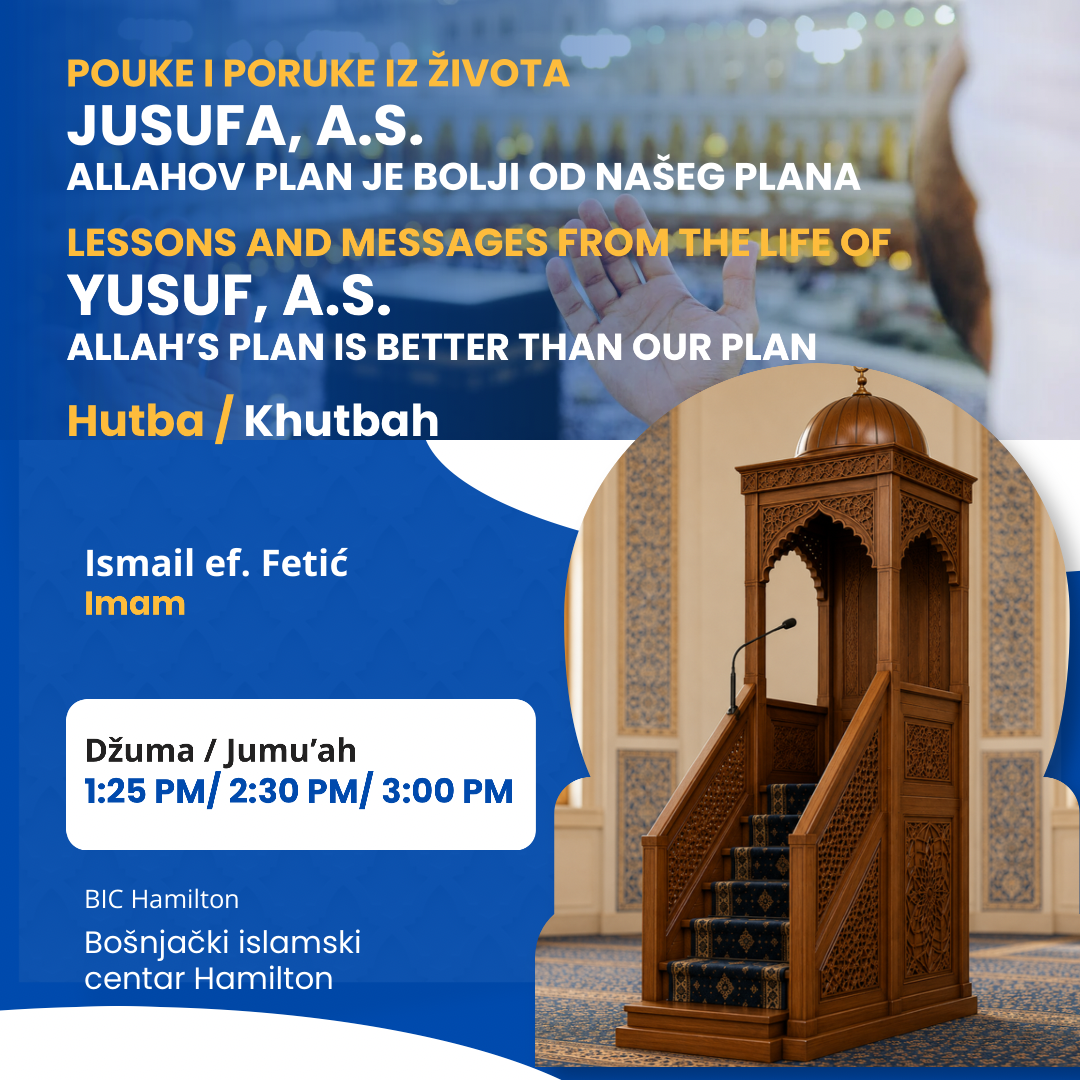 Pouke i poruke iz života Jusufa a.s.
Allahov plan je bolji od našeg plana
Hvala Allahu, Gospodaru svih svjetova. Njega hvalimo, od Njega pomoć i oprost tražimo i molimo Ga da nas uputi i učvrsti na Pravome putu. Neka su salavat i selam na našeg voljenog Poslanika Muhammeda, sallallahu alejhi ve sellem, njegovu porodicu, ashabe i sve one koji slijede njegov put do Sudnjeg dana.
Draga braćo i sestre,
Među svim kazivanjima koja nam Allah Uzvišeni prenosi u Kur’anu posebno mjesto zauzima kazivanje o Jusufu, a.s. Allah je cijelu jednu suru nazvao njegovim imenom i za nju rekao: „Mi ti kazujemo najljepše kazivanje.“ (Jusuf, 3)
To nije samo priča o jednom poslaniku koji je živio prije mnogo stoljeća. To je priča o životu, iskušenjima, strpljenju, čednosti, oprostu i povjerenju u Allaha. To je priča koja nas uči da Allahov plan često ne razumijemo dok prolazimo kroz iskušenje, ali ga prepoznamo kasnije, kada pogledamo unazad i vidimo kako nas je Allah vodio.
Braćo i sestre,
Jusuf, a.s., je bio voljeni sin Allahovog poslanika Jakuba, a.s. Bio je obdaren ljepotom, plemenitim karakterom i posebnim Allahovim darovima. Ipak, njegov život nije počeo lagodno.
Njegova vlastita braća postala su ljubomorna na njega. Odveli su ga daleko od kuće i bacili u duboki bunar, a zatim se vratili ocu sa lažnom pričom.
Zamislite tog dječaka samog na dnu bunara. Odvojen od porodice, ne znajući šta će se dogoditi. U tom trenutku nije mogao vidjeti izlaz. Nije znao da će ga Allah jednog dana iz tog bunara odvesti do položaja kakav nije mogao ni zamisliti. Ali Allah je znao.
To je prva velika pouka njegovog života. Postoje trenuci kada ne razumijemo ono što nam se događa. Postoje vrata koja se zatvore, planovi koji propadnu i ljudi koji nas razočaraju. Mi vidimo samo ono što je pred nama, dok Allah vidi cijeli put.
Koliko puta smo kasnije shvatili da je nešto što smo smatrali nesrećom zapravo bilo dobro za nas? Koliko puta nas je Allah udaljio od onoga što smo željeli kako bi nas doveo do nečega boljeg?
Vjernik zna da Allah nikada ne gubi kontrolu nad njegovim životom, čak ni onda kada se njemu čini da je sve izmaklo kontroli.
Draga braćo i sestre,
Nakon bunara dolazi novo iskušenje. Jusuf, a.s., biva prodan kao rob i odveden u tuđu zemlju. Od sina Allahovog poslanika postaje čovjek bez slobode.
Ovo nas podsjeća da naša vrijednost nije određena položajem koji imamo među ljudima. Danas mnogi svoju vrijednost mjere titulama, novcem, kućama, poslovima i društvenim ugledom. Allah, međutim, gleda naše srce, našu vjeru i naša djela.
Čovjek može biti nepoznat ljudima, a veoma vrijedan kod Allaha. Može imati malo dunjaluka, a biti bogat imanom.
Braćo i sestre,
Jedno od najvećih iskušenja Jusufa, a.s., bilo je iskušenje strasti. Kada ga je žena uglednog čovjeka pokušala navesti na grijeh, imao je priliku učiniti ono što nije dozvoljeno. Bio je daleko od svoje porodice i niko od ljudi ga nije mogao vidjeti. Ali Jusuf, a.s., je znao da ga Allah vidi. Zato je rekao: „ Sačuvaj Bože.“ (Jusuf, 23)
To je poruka koja nam je danas potrebnija nego ikada. Živimo u vremenu kada se čovjek podstiče da slijedi svoje strasti i radi ono što mu donosi trenutno zadovoljstvo. Jusuf, a.s., nas uči da prava sloboda nije raditi sve što poželimo. Prava sloboda je biti gospodar svojih strasti, a ne njihov rob.
Draga braćo i sestre,
Nakon što je odbio grijeh, Jusuf, a.s., nije odmah nagrađen. Naprotiv, završio je u zatvoru. Mnogi bi rekli: „Trudio sam se biti dobar, a opet sam kažnjen.“ Ali Jusuf, a.s., nije izgubio vjeru u Allaha. Čak i u zatvoru ostao je čovjek vjere, morala i dobrote. Pomagao je ljudima i pozivao ih Allahu. Nije dozvolio da ga okolnosti promijene.
Nemoj prestati biti dobar zato što ti drugi nisu uzvratili dobrotom. Nemoj prestati činiti dobro zato što te ljudi nisu cijenili. Čini dobro radi Allaha, jer nijedno dobro djelo kod Njega nije izgubljeno.
Braćo i sestre,
Nakon godina iskušenja dolazi Allahova pomoć. Jusuf, a.s., izlazi iz zatvora i postaje jedan od najutjecajnijih ljudi svoga vremena. Od dječaka u bunaru dolazi do palače. Od roba postaje ugledan čovjek, a od zatvorenika čovjek kojem se drugi obraćaju za pomoć. Ali ono što najviše zadivljuje nije njegov položaj nego njegov karakter.
Kada su njegova braća stala pred njega, imao je priliku vratiti im za sve što su mu učinili. Mogao ih je poniziti i kazniti. Ali rekao je: „Danas vam se neće ništa prigovoriti. Neka vam Allah oprosti. On je od milostivih Najmilostiviji.“ (Jusuf, 92)
Koliko nam je potrebna ova poruka.
Mnogi ljudi godinama nose teret ljutnje, mržnje i starih uvreda. Misle da time kažnjavaju druge, a zapravo opterećuju vlastito srce.
Jusuf, a.s., nas uči da oprost nije znak slabosti. Oprost je znak snage. Veliko je srce koje može oprostiti onda kada ima mogućnost da se osveti.
Draga braćo i sestre,
Mi živimo u vremenu kada ljudi žele uspjeh bez čekanja, nagradu bez truda i rezultate bez iskušenja. Priča o Jusufu, a.s., podsjeća nas da Allah odgaja Svoje robove kroz vrijeme i različita iskustva.
Bunar nije bio kraj njegovog puta. Robovanje nije bilo kraj. Zatvor nije bio kraj. Sve je bilo dio Allahovog plana.
Možda i ti danas prolaziš kroz svoj bunar. Možda prolaziš kroz neizvjesnost, bolest, finansijske probleme ili porodična iskušenja. Možda ne razumiješ zašto se neke stvari događaju u tvom životu. Sjeti se Jusufa, a.s. Možda još ne vidiš ono što Allah priprema za tebe, ali Allah vidi.
Braćo i sestre,
Priča o Jusufu, a.s., uči nas da budemo strpljivi kada ne razumijemo Allahovu odredbu, da ostanemo čestiti kada nas grijeh poziva, da činimo dobro kada nam drugi ne uzvraćaju dobrotom i da oprostimo kada imamo priliku za osvetu.
Najveća poruka njegovog života jeste da je Allahov plan bolji od našeg plana. Mi vidimo jedan trenutak, a Allah vidi cijeli život. Mi vidimo prepreku, a Allah vidi put. Mi vidimo bunar, a Allah vidi palaču.
Molimo Allaha Uzvišenog da nam podari strpljenje poput strpljenja Jusufa, a.s., čednost poput njegove čednosti, oprost poput njegovog oprosta i povjerenje u Allahov plan čak i onda kada ga ne razumijemo. Amin, ja Rabbi-l-’alemin.
Lessons and messages from the life of Yusuf a.s.
Allah’s plan is better than our plan
All praise is due to Allah, the Lord of all worlds. We praise Him, we seek His help and forgiveness, and we ask Him to guide us and keep us firm on the Straight Path. May Allah’s peace and blessings be upon our beloved Prophet Muhammad, sallallahu alayhi wa sallam, his family, his Companions, and all those who follow his path until the Day of Judgment.
Dear brothers and sisters,
Among all the stories that Allah Almighty tells us in the Qur’an, the story of Yusuf (a.s.) holds a special place. Allah named an entire surah after him and said: “We relate to you the best of stories.” (Surah Yusuf, 12:3)
This is not simply the story of a Prophet who lived many centuries ago. It is a story about life, hardship, patience, purity, forgiveness, and trust in Allah. It teaches us that we often do not understand Allah’s plan while we are going through a difficult time. Sometimes we understand it only later, when we look back and realize how Allah was guiding us all along.
Dear brothers and sisters,
Yusuf (a.s.) was the beloved son of the Prophet Ya‘qub (a.s.). Allah blessed him with beauty, noble character, and special gifts. Yet his life was not an easy one.
His own brothers became jealous of him. They took him far away from home, threw him into a deep well, and then returned to their father with a false story.
Imagine that young boy alone at the bottom of a well, separated from his family and not knowing what would happen next. At that moment, Yusuf (a.s.) could not see a way out. He did not know that one day Allah would take him from that well to a position he could never have imagined. But Allah knew.
This is one of the first great lessons from his life. There are moments when we do not understand what is happening to us. Doors close. Plans fail. People disappoint us. We see only what is directly in front of us, while Allah sees the entire road ahead.
How many times have we looked back and realized that something we thought was bad for us actually turned out to be good? How many times did Allah take us away from something we wanted, only to lead us toward something better? A believer knows that Allah is always in control, even when life seems completely out of control.
Dear brothers and sisters,
After the well came another trial. Yusuf (a.s.) was sold into slavery and taken to a foreign land. The son of a Prophet became a man without freedom.
This reminds us that our true value is not determined by our position among people. Today, many measure their worth by titles, money, homes, careers, or social status. But Allah looks at something much deeper: our hearts, our faith, and our deeds. A person may be unknown among people but highly honoured by Allah. A person may have little of this dunya but possess great wealth in faith.
Dear brothers and sisters,
One of the greatest tests in the life of Yusuf (a.s.) was the temptation to commit sin. When the wife of an influential man tried to seduce him, he had an opportunity to do something forbidden. He was far away from his family, and no one seemed to be watching. But Yusuf (a.s.) knew that Allah was watching. So he said: مَعَاذَ اللَّهِ “I seek refuge in Allah.” (Surah Yusuf, 12:23)
This is a message we need today more than ever. We live in a time when people are constantly encouraged to follow their desires and pursue whatever brings immediate pleasure. Yusuf (a.s.) teaches us that real freedom does not mean doing whatever we want.
Real freedom means being in control of our desires instead of becoming slaves to them.
Dear brothers and sisters,
After refusing to commit that sin, Yusuf (a.s.) was not immediately rewarded. Instead, he ended up in prison. Many people in such a situation might say, “I tried to do the right thing, so why am I being punished?”
But Yusuf (a.s.) did not lose his faith in Allah. Even in prison, he remained a man of faith, character, and goodness. He helped people and called them toward Allah. He did not allow his circumstances to change who he was. Do not stop being a good person because others did not return your kindness. Do not stop doing good because people failed to appreciate you. Continue doing good for the sake of Allah, because no good deed is ever lost with Him.
Dear brothers and sisters,
After years of hardship, Allah’s help came. Yusuf (a.s.) left prison and became one of the most influential men of his time. The boy who had been thrown into a well eventually reached the palace. The slave became a respected leader, and the prisoner became someone people turned to for help.
But what is most remarkable about Yusuf (a.s.) is not his position. It is his character. When his brothers eventually stood before him, Yusuf had the power to repay them for everything they had done. He could have humiliated them. He could have punished them. He could have taken revenge.Instead, he said: “There is no blame upon you today. May Allah forgive you. He is the Most Merciful of those who show mercy.” (Surah Yusuf, 12:92)
How much we need this lesson today.
Some people carry anger, resentment, and old wounds for years. They believe they are punishing the person who hurt them, but in reality, they are burdening their own hearts.
Yusuf (a.s.) teaches us that forgiveness is not weakness. Forgiveness is strength. It takes a great heart to forgive when you have the power to take revenge.
Dear brothers and sisters,
We live in a time when people want success without waiting, rewards without effort, and results without hardship. But the story of Yusuf (a.s.) reminds us that Allah develops His servants through time, patience, and different experiences.
The well was not the end of his journey. Slavery was not the end. Prison was not the end. Every stage was part of Allah’s plan.
Perhaps today you are going through your own well. Perhaps you are facing uncertainty, illness, financial difficulty, family problems, or another test that no one else fully understands. Perhaps you are wondering why certain things are happening in your life. Remember Yusuf (a.s.). You may not yet see what Allah is preparing for you. But Allah sees.
Dear brothers and sisters,
The story of Yusuf (a.s.) teaches us to be patient when we do not understand Allah’s decree, to remain pure when sin calls us, to continue doing good even when others do not return our kindness, and to forgive when we have the opportunity to take revenge.
And perhaps the greatest lesson from his life is this: Allah’s plan is better than our plan. We see one moment, but Allah sees our entire life. We see an obstacle, but Allah sees a road. We see a well, but Allah sees a palace.
We ask Allah Almighty to grant us patience like the patience of Yusuf (a.s.), purity like his purity, forgiveness like his forgiveness, and complete trust in Allah’s plan even when we do not understand it. Ameen, Ya Rabb al-‘Alameen.
Imam Ismail Fetic